Physics-Informed Machine Learning (PIML) of Manufacturing Dynamics
Introduction
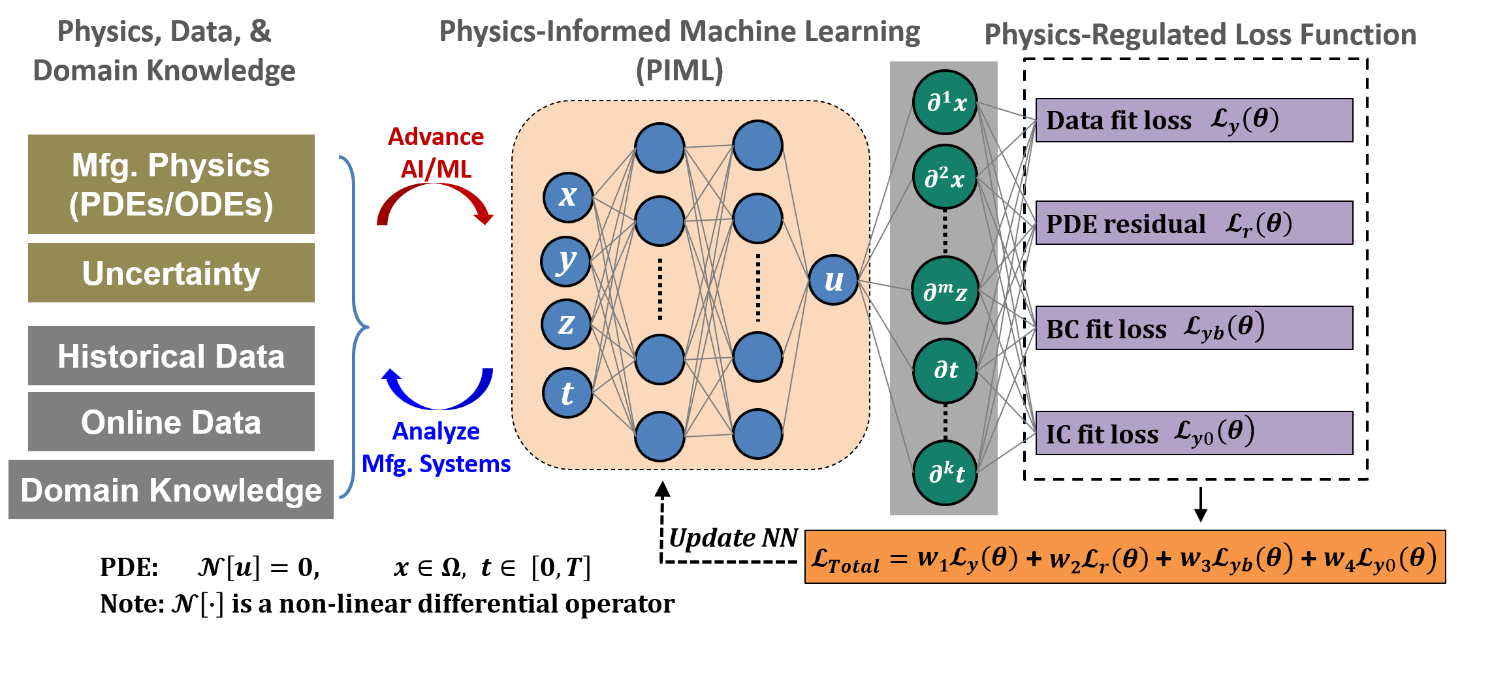
The complex manufacturing dynamics are characterized by non-linear effects, unknown physics, high dimensionality, and uncertainty, which significantly impact productivity, quality, and flexibility. Understanding and predicting such complex manufacturing dynamics (e.g., saw-tooth chips in hard cutting, metal pool dynamics in metal additive manufacturing) remain central intractable problems for producing high-quality components or advanced materials. Compared with conventional physics-based modeling approaches such as finite element methods (FEM) and computational fluid dynamics (CFD), machine learning (ML) can leverage high-dimensional, online process data for real-time model updating, prediction, and process control. However, purely data-driven ML models are black-box, inherently computation-intensive, and storage-intensive. A deep knowledge gap exists between ML and physics-based models in predicting complex manufacturing dynamics. Physics-informed machine learning (PIML) is an emerging paradigm that integrates fundamental physical laws (e.g., those governing partial differential equations) with data-driven learning to forward-predict, inverse-learn, and discover complex manufacturing dynamics. Unlike purely data-driven approaches, PIML embeds governing equations, conservation principles, and process-specific constraints into machine learning models, enabling them to learn accurate and physically consistent representations even when experimental data are sparse or noisy. In manufacturing processes such as metal additive manufacturing, where highly nonlinear, multiscale, and transient dynamics are governed by coupled thermal, mechanical, and material interactions, PIML provides a powerful framework (Figure 1) for combining first-principles knowledge with sensor data. This hybrid approach enhances model generalization, improves interpretability, and facilitates real-time process monitoring, digital twins, and predictive control, making it a promising technology for intelligent and autonomous manufacturing systems.
Recent Projects
- Collaborative Research: Energy-Based Prognosis for Surface Integrity through Integration of Process Physics and Machine Learning, National Science Foundation, 2021.
- CDS&E: Computation-Informed Learning of Melt Pool Dynamics for Real-Time Prognosis, National Science Foundation, 2022.
- Collaborative Research: Physics-Informed Learning and Mitigating of Fatigue Scattering in Powder Bed Fusion, National Science Foundation, 2024.
Representative Publications
- Patel, D., Sharma, R., Guo, Y.B., 2025, Computational, data-driven, and physics-informed machine learning approaches for microstructure modeling in metal additive manufacturing, Annual Review of Heat Transfer, 2025 https://doi.org/10.1615/AnnualRevHeatTransfer.2025059621
- Huang, Y., Han, F., Liu, W., Yi, Y., Guo, Y.B., 2025, Machine learning-based online stability lobe diagram estimation and chatter suppression control in milling process, 2025, arXiv preprint arXiv:2511.17894
- Sharma, R., Guo, Y.B., 2025, Thermo-mechanical physics-informed deep learning for prediction of thermal stress evolution in laser metal deposition, Engineering Applications of Artificial Intelligence, v.157, https://doi.org/10.1016/j.engappai.2025.111554
- Sharma, R., Guo, Y.B., Raissi, M., Guo, W., 2024, Physics-informed machine learning of argon gas-driven melt pool dynamics, Journal of Manufacturing Science and Engineering, v.146, https://doi.org/10.1115/1.4065457
- Sharma, R., Raissi, M., Guo, Y.B., 2023, Physics-informed deep learning of gas flow-melt pool multi-physical dynamics during powder bed fusion", CIRP Annals, https://doi.org/10.1016/j.cirp.2023.04.005
- Guo, S., Agarwal, M., Cooper, C., Tian, Q., Gao, R., Guo, W., Guo, Y.B., 2022, Machine learning for metal additive manufacturing: Towards a physics-informed data-driven paradigm, Journal of manufacturing systems, v.62, https://doi.org/10.1016/j.jmsy.2021.11.003
- Guo, W., Tian, Q., Guo, S., Guo, Y.B., 2020, A physics-driven deep learning model for process-porosity causal relationship and porosity prediction with interpretability in laser metal deposition, CIRP Annals-Manufacturing Technology v.69, https://doi.org/10.1016/j.cirp.2020.04.049
- Liu, Z.Y., Guo, Y.B., 2018, A hybrid approach to integrate machine learning and process mechanics for the prediction of specific cutting energy, CIRP Annals-Manufacturing Technology v.67 https://doi.org/10.1016/j.cirp.2018.03.015
Intelligent Digital Twins
Introduction
The concept of Intelligent Digital Twins (iTwin) is an emerging transformative paradigm in how to simulate, predict, and control complex physical systems using AI/ML. The key rationale behind a digital twin (DT) lies in the motivation to bridge the critical gap between traditional static models and live data streams representing the dynamic and evolving nature of physical systems. Since the initial idea and terminology of DT were introduced, different definitions and understandings of DT have evolved over time across various domains. A DT can be defined as a digital replica of a physical entity (e.g., a process, machine, or system) with a live, bidirectional connection between the physical and digital entities (e.g., milling iTwin in Figure 2). A DT ecosystem has four key elements: a physical system, a digital replica (e.g., simulations, AI/ML models), a data stream, and feedback control. DTs act as dynamic, data-driven models that enable real-time monitoring, simulation, and optimization using data from various sources (e.g., IoT sensors). DTs can be of different types, such as physics-based simulations (e.g., FEA, CFD) and data-driven models (e.g., AI/ML). Intelligent manufacturing DTs are virtual representations of physical processes, systems, or supply chains that integrate real-time data, AI/ML, and advanced control to mirror, monitor, and optimize their real-world counterparts. Unlike conventional DTs, intelligent DTs continuously learn from operational data, enabling predictive insights, autonomous decision-making, and adaptive control for smart manufacturing. By combining the Internet of Things (IoT), AI/ML, and advanced control technologies, intelligent DTs capture manufacturing system dynamics with high fidelity, enabling real-time prediction, prescriptive decision-making, and adaptive control across the manufacturing value chain, leading to higher productivity, reduced downtime, and more resilient operations.

Recent Projects
- Collaborative Research: Fusion of Siloed Data for Multistage Manufacturing Systems: Integrative Product Quality and Machine Health Management, National Science Foundation, 2024.
- Toward Next-Generation “Intelligent” Pharmaceutical Drug Product Manufacturing for Efficient Patient Healthcare, Rutgers Research Council Award, 2024.
- Siemens Experiential 5G Robotic Manufacturing Learning Program, Siemens Corporate Technology, 2023.
- Leveraging Digital Twin for Novel Materials Development via Additive Manufacturing, Rutgers/iMR, 2019.
Representative Publications
- Y. Huang, J. Yi, Y.B. Guo, 2026, Physics-driven real-time, intelligent digital twin for adaptive milling chatter control, CIRP Annals-Manufacturing Technology, doi.org/10.1016/j.cirp.2026.04.032
- W. Liu, R. Sharma, W. Guo, J. Yi, Y.B. Guo, 2026, Real-time AI-driven milling digital twin towards extreme low-latency, Engineering, doi.org/10.1016/j.eng.2025.12.028
- B. Chen, E. Shata, S. Shekhar, C. Mahmoudi, Y.B. Guo, 2025, Laser scanning-based precision defect identification for autonomous robotic part repair, IEEE/ASME Transactions on Mechatronics, doi: 10.1109/TMECH.2025.3571682
- M. Rahman, J. Oyedum, I. Seskar, Y. Guo, N. Mandayam, Y. Chen, 2025, Digital twin of wireless physical layer in advanced manufacturing environment, IEEE Future Networks World Forum (FNWF), 2025 https://doi.org/10.1109/FNWF66845.2025.11317372
- Y.B. Guo, A. Klink, P. Bartolo, W. Guo, 2023, Digital twins for electro-physical, chemical, and photonic processes, CIRP Annals-Manufacturing Technology (keynote), 72/2: 593-619, https://doi.org/10.1016/j.cirp.2023.05.007
NextG-Enabled Smart Manufacturing
Introduction
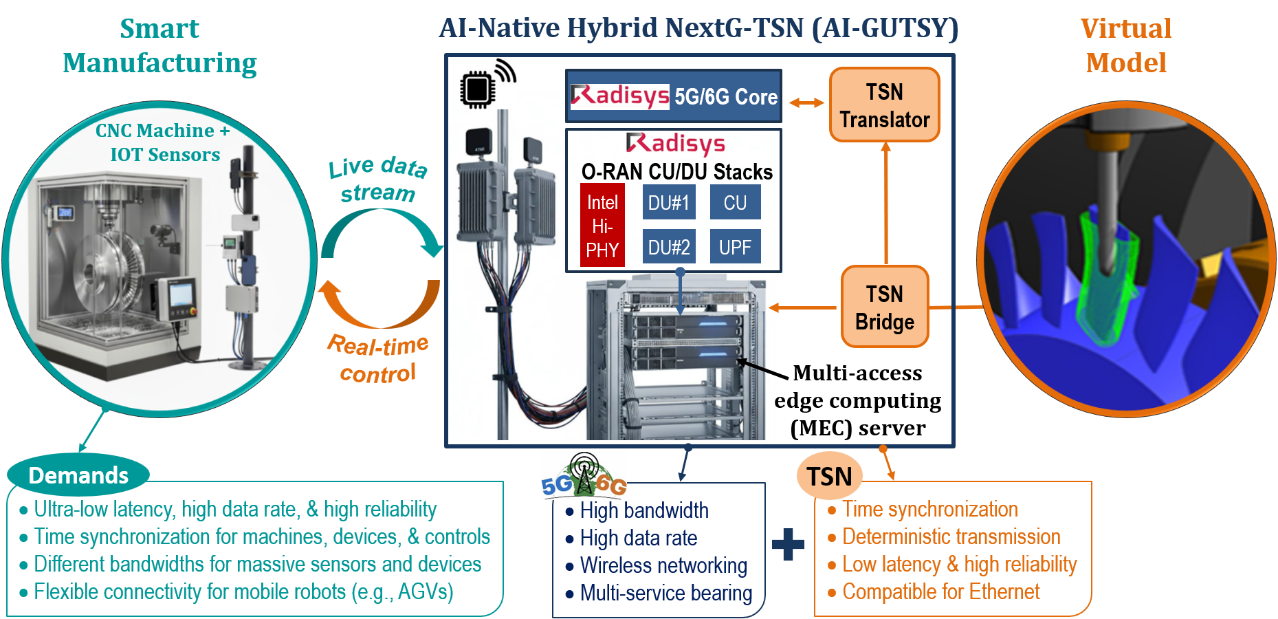
Compared to conventional wire-bound Ethernet and industrial wireless (e.g., iWLAN) technologies, the advent of 5G and future 6G wireless communication (hereafter NextG) may reshape smart manufacturing or Industry 4.0 fundamentally because NextG can meet the stringent production demands (Figure 3), such as ultra-low latency (<10 ms), high-rate live data streaming (>1.5 Gbps), high reliability (99.999%+), time synchronization, massive-device connectivity, and integrated wired-wireless convergence. NextG-enabled smart manufacturing integrates AI-native NextG network with advanced sensing, AI/ML, robotics, edge computing, and digital twins to create highly connected, responsive, and adaptive manufacturing systems. The integrated multi-access edge computing (MEC), sensing and communications (ISAC), ultra-reliable low-latency communication (URLLC), time-sensitive networking (TSN), and enhanced network slicing enable deterministic performance for diverse manufacturing workloads—from real-time CNC machine control and sensor data processing to high-definition video analytics and predictive optimization and control. Machine learning models may allocate the network resources (e.g., bandwidth, latency, and reliability) dynamically and safely based on the real-time traffic needs of each device, whether it’s sensor data, machine control commands, or video streams. Furthermore, use-inspired testbeds have been developed to showcase the transformative performance/capability enabled by the AI-native NextG network and provide innovative platforms for technology demonstration and translation in a phased approach.
Recent Projects
- FMRG: Cyber: Manufacturing USA: NextG-Enabled Manufacturing of the Future (NextGEM), National Science Foundation, 2024.
- 5G-Enabled Legacy Machinery for Low-Cost Sensing and Connectivity, Manufacturing USA Institute/CESMII, DOE, 2022.
- Siemens Experiential 5G Robotic Manufacturing Learning Program, Siemens Corporate Technology, 2022.
- 5G Testbed for Robotic Manufacturing, Siemens Corporate Technology, 2021.
Representative Publications
- Liu, W., Sharma, R., Guo, W., Yi J., Guo, Y.B., 2026, Real-time AI-driven milling digital twin towards extreme low-latency, Engineering, https://doi.org/10.1016/j.eng.2025.12.028
- Oyedum, C., Rahman, M., Seskar, I., Guo, Y.B., Chen, Y., Mandayam, N., 2025, Measurement, Modeling and Analysis of the Impact of Machine-Generated Noise on OFDM Signal Reception in Advanced Manufacturing, GLOBECOM IEEE Global Communications Conference, 6147-6152, https://doi.org/10.1109/GLOBECOM59602.2025.11432514
- Hu, L., Guo, Y.B., Seskar, I., Chen, Y., Mandayam, N., Guo, W., Yi, J., 2024, NextG manufacturing - New extreme manufacturing paradigm from the temporal perspective, Journal of Manufacturing Systems, 77: 418-431, https://doi.org/10.1016/j.jmsy.2024.10.008
- Hu, L., Chen, B., Shata, E., Shekhar, S., Mahmoudi, C., Seskar, I., Zou, Q., Guo, Y.B., 2024, Feasibility of 5G-enabled process monitoring in milling operations, Manufacturing Letters, 41:200–207, https://doi.org/10.1016/j.mfglet.2024.09.024
- H. Shata, B. Chen, L. Hu, Q. Zou, Y.B. Guo, C. Mahmoudi, S. Shekhar, I. Seskar, 2024, 5G-Cloud-based real-time robotic part repairing for advanced manufacturing via computer vision, Manufacturing Letters, 41:1398–1404, https://doi.org/10.1016/j.mfglet.2024.09.166
Data-Driven Manufacturing Process-Surface Integrity-Functionality Relationships
Introduction
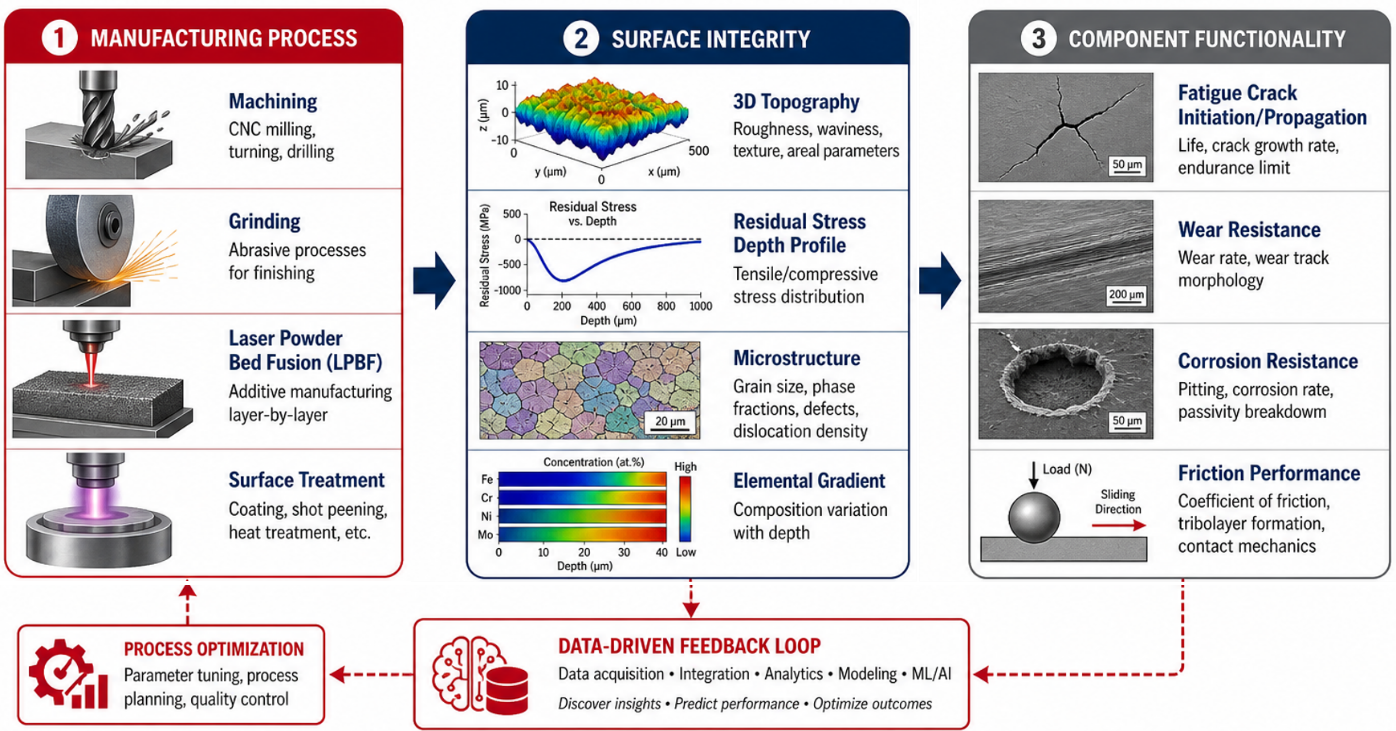
Data-driven manufacturing process–surface integrity–functionality relationships is an emerging paradigm that leverages sensing, data analytics, machine learning, and physics-based modeling to establish quantitative links between manufacturing processes, the resulting surface integrity, and component functionality. Manufacturing processes such as machining, additive manufacturing, forming, and heat treatment generate complex surface and subsurface characteristics—including roughness, residual stress, microstructure, hardness, defects, and element gradient—that directly influence product performance, such as fatigue life, wear resistance, corrosion behavior, and other functional properties. By integrating real-time process data, in-situ monitoring, metrology, and advanced analytics, data-driven approaches enable the discovery of hidden correlations and predictive relationships among process parameters, surface integrity metrics, and functional outcomes. These models support intelligent process optimization, adaptive control, and digital twins that can predict component performance before deployment. Ultimately, this framework (Figure 4) enables manufacturers to transition from traditional parameter-based production to functionality-oriented manufacturing, where products are designed and controlled to achieve targeted performance, quality, sustainability, and lifecycle objectives.
Recent Projects
- Collaborative Research: Metal Additive Manufacturing, Fatigue Scattering, Physics-Informed Machine Learning, Material Characterization, National Science Foundation, 2024.
- Collaborative Research: Fusion of Siloed Data for Multistage Manufacturing Systems: Integrative Product Quality and Machine Health Management, National Science Foundation, 2023.
Representative Publications
- Kousoulas, P., Sharma, R., Guo, Y.B., 2026, Integrated physics-informed learning and resonance process signature for the prediction of fatigue crack growth for laser-fused alloys, Journal of Manufacturing Science and Engineering, v.148, https://doi.org/10.1115/1.4071939
- Bansal, V., Kousoulas, P., Zhou, S., Guo, Y.B., 2026, Bayesian hierarchical fatigue scattering model for laser-fused metal components, Journal of Manufacturing Science and Engineering, v.148, https://doi.org/10.1115/1.4071940
- Kousoulas, P., Bansal, V., Xi, Z., Zhou, S., Guo, Y.B., 2025, Fatigue modeling for laser-fused metal components with small data: from scattering to reliability, Journal of Manufacturing Science and Engineering, v.147, https://doi.org/10.1115/1.4069197
- Bansal, V, Kousoulas, P., Zhou, S., Guo, Y.B., 2025, Deep learning based anomaly detection for laser-fused metal components using pyrometric data, Journal of Manufacturing Science and Engineering, v.148, https://doi.org/10.1115/1.4070270
- Liu, B., Guo, Y.F., Guo, Y.B., Guo, W., 2025, Predictive modeling of surface topography using power data in wire electrical discharge machining, Journal of Computing and Information Science in Engineering, v.25, https://doi.org/10.1115/1.4069964
- Kousoulas, P., Guo, Y.B., 2024, Fatigue scattering analytics and prediction of ss 316L fabricated by laser powder bed fusion, Journal of Manufacturing Science and Engineering, v.147, https://doi.org/10.1115/1.4066803
Fabrication of Multifunctional Composites and Coatings
Introduction
For decades, society has benefited from the designer nanoengineered architectures in the form of microelectronics. Nanotechnology has also been applied in the medical and general consumer scale; however, the recent progress in nanomaterials synthesis and control over self-assembly provides much greater opportunity to leverage the extraordinary properties of nanomaterials for a wide range of applications. Through compositional and microstructural control, we seek to create composites that are scalably manufactured and co-optimized for multifunctionality, including mechanical, electrical, reactive, thermal, and optical properties. At NJAMI, we characterize these materials through dynamic mechanical analysis at the macro- and micro-scale, spectroscopic analysis, and optical profilometry and confocal mapping. In addition, we are studying the continuous roll-to-roll manufacturing of multifunctional composite coatings with implications in aerospace structures, drug delivery, protective textiles, filtration, and next-generation consumer goods.

Recent Projects
- Formable Ordered Microcomposite Energetics (FOMEs), Defense Advanced Research Projects Agency, 2024.
- Microporous Nanocomposite Multifunctional Carbon Fiber Composites, Office of Naval Research, 2021.
- Metallization of Carbon Fiber Composites, Boeing Corporation, 2021.
- Structures for Acoustic Dampening, Northrop Grumman, 2021.
- Collaborative Research: Multi-Scale Micromechanical Properties of Hierarchical Coatings and Interfaces Fabricated by Self-Limiting Electrospray Deposition, National Science Foundation, 2020.
- Self-Limiting Electrospray Deposition of Bioactive Device Coatings, GeneOne Life Science, 2019.
Representative Publications
- Patel, Y.; Huan Sun, P.; Llumiquinga, B.; Bao, N.; Shi, J.; Duran, A.; Nicholas, C. O.; Mohanty, R.; Cho, N.; You, I.; et al. Enhancing thermal conductivity and flame resistance of carbon fiber composites using CNT-infused multiphase graphene resins. Nanoscale 2026, 18 (1), 384-395. DOI: https://doi.org/10.1039/d5nr03659c
- Llumiquinga, B.; You, I.; Eidle, L.; Green-Warren, R. A.; Saro-Cortes, V.; Edralin, J. P.; Rodriguez, L. R. M.; Pelegri, A. A.; Singer, J. P. Durable Metallization of Resin Surfaces via Sacrificial Nanotransfer Lithography. Advanced Materials Interfaces 2024, 11 (25), 2400251. DOI: https://doi.org/10.1002/admi.202400251
- Grzenda, M. J.; Yu, J.; Atzampou, M.; Shuck, C. E.; Gogotsi, Y.; Zahn, J. D.; Singer, J. P. Microscale Templating of Functional Particles Using Self-Limiting Electrospray Deposition. Small 2024, e2405509. DOI: 10.1002/smll.202405509
- Ren, Z.; Green-Warren, R.; McAllister, N.; Kim, A.; Shaikh, A.; Pelegri, A. A.; Singer, J. P.; Lee, J.-H. Enhanced mechanical energy absorption via localized viscoplasticity of nano-cellular polymer coating under supersonic impact loading. Giant 2023, 15, 100180. DOI: https://doi.org/10.1016/j.giant.2023.100180
- Park, S. H.; Lei, L.; D’Souza, D.; Zipkin, R.; DiMartini, E. T.; Atzampou, M.; Lallow, E. O.; Shan, J. W.; Zahn, J. D.; Shreiber, D. I.; et al. Efficient electrospray deposition of surfaces smaller than the spray plume. Nature Communications 2023, 14 (1), 4896. DOI: https://doi.org/10.1038/s41467-023-40638-7
- Green-Warren, R. A.; Bontoux, L.; McAllister, N. M.; Kovacevich, D. A.; Shaikh, A.; Kuznetsova, C.; Tenorio, M.; Lei, L.; Pelegri, A. A.; Singer, J. P. Determining the Self-Limiting Electrospray Deposition Compositional Limits for Mechanically Tunable Polymer Composites. ACS Applied Polymer Materials 2022, 4 (5), 3511-3519. DOI: https://doi.org/10.1021/acsapm.2c00106